Loading
DistributeIQ
One ledger, from the order to the doorstep
A distribution system for the businesses that move goods from warehouse to outlet. Orders, load sheets, delivery, crates, payments, and settlement share one set of books. Drivers keep working when the signal drops, and the ledger catches up when the phone does.
Live · Web and Android
Distribution, from the order to the settlement
Tax rates are stored on the invoice line. Reprinting last year does not rewrite last year's tax.
- Chain
- Order to settlement
- Field
- Offline Android
- Books
- GST and Tally
- Roles
- Seven
01How it works
It reads. It shows. Your team decides.
The day is recorded where it happens: at the desk, at the gate, on the doorstep. What the owner reads in the evening is the same set of records.
- 01It reads
The whole working day
Every order, load sheet, stop, crate, and payment, recorded where it happens. On the route that means offline if it has to be.
- 02It shows
What changed, and where
Which distributors have not ordered, whose credit is stretched, and how this week compares with last. Computed on business dates, so a late sync still lands on the right day.
- 03Your team decides
What leaves the gate
Credit warnings appear on the load sheet, before anything is dispatched. What ships, and which distributor gets a call, stays a person’s decision.
02In practice
One day, six moments.
A working day in the order the platform runs it, from the catalogue in the morning to the books at night.
- 01
Catalogue
SKUs in box, crate, kilogram, or litre. Price tiers are set once and applied to every order.
- 02
Order
A distributor orders in the app or by phone. Stock is reserved and a GST invoice is raised together.
- 03
Load
The warehouse checks each line. Credit warnings show before anything leaves the gate.
- 04
Delivery
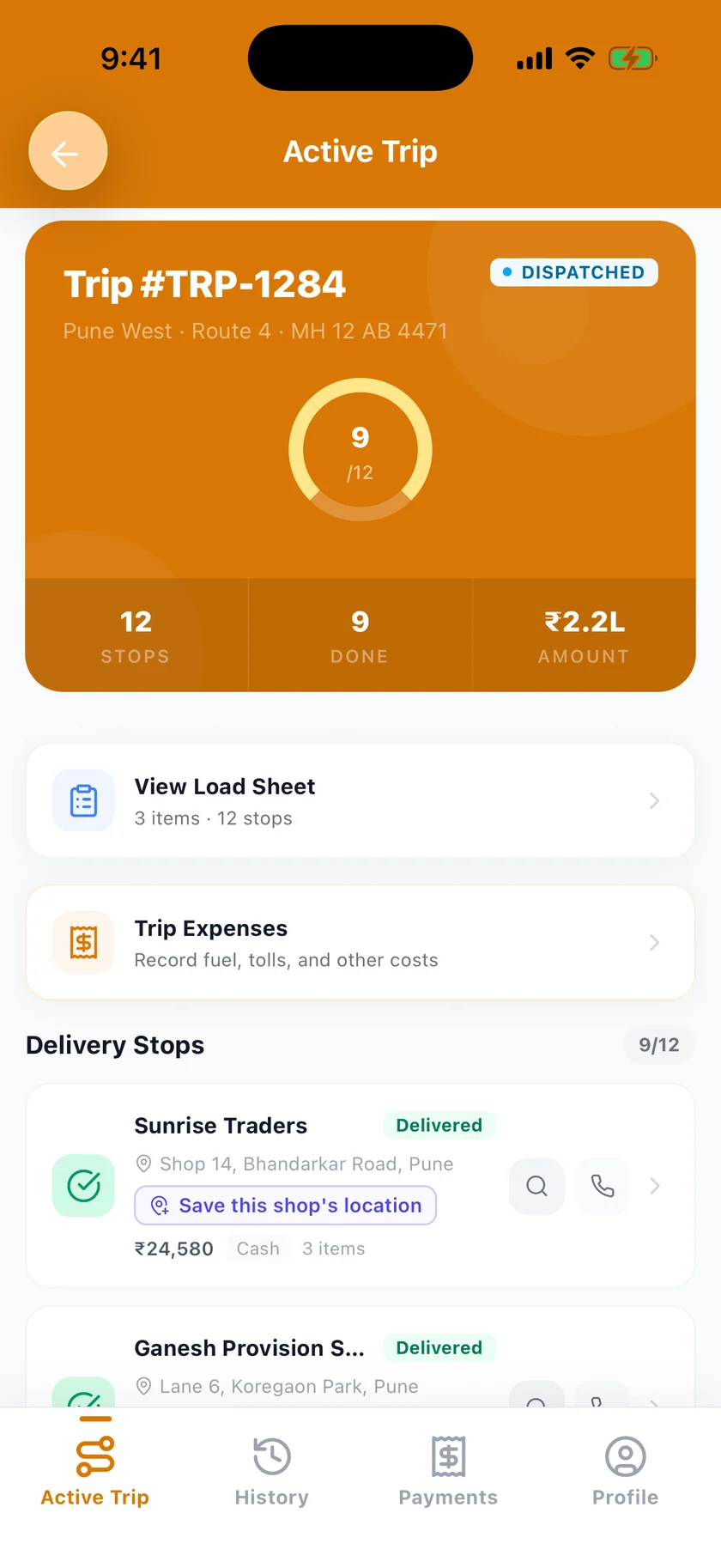
The driver verifies items, collects payment, swaps crates, and captures proof — offline if needed.
- 05
Settlement
Cash, advances, and expenses close the trip. The daily cash sheet is ready route by route.
- 06
Books
Revenue, credit, and route numbers already match the ledger. Nobody retypes the day into a sheet.
03The intelligence
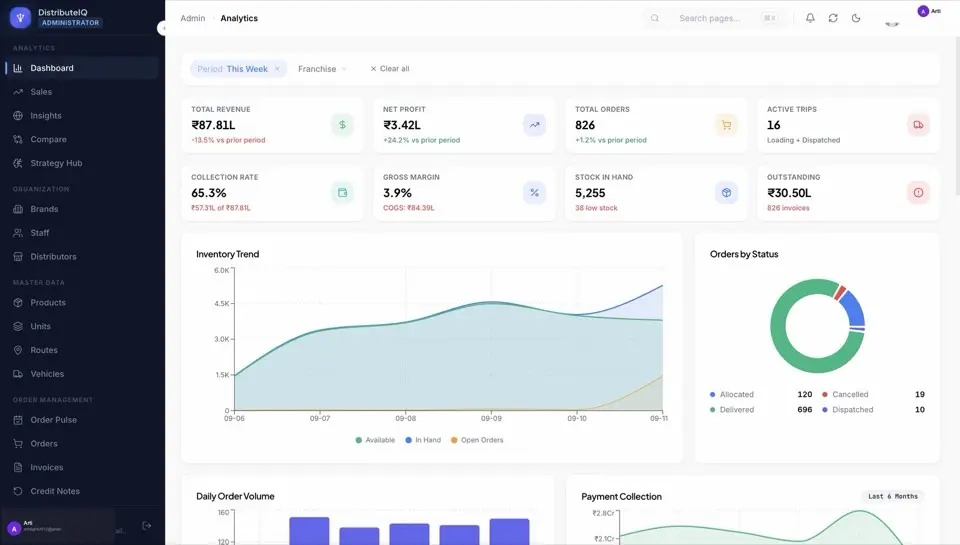
Analytics that match the books.
The product calls itself intelligence-driven distribution. The intelligence is this: every figure is computed from the ledger the invoices come from, so the dashboard and the books cannot disagree.
- 03.1
Order Pulse
The day’s coverage on one board: which distributors have ordered, and which have gone quiet. The team works the gaps instead of reading yesterday’s report.
- 03.2
Credit warnings at the gate
They appear on the load sheet before the goods leave, which is the only point where they still cost nothing.
- 03.3
Insights
Collection efficiency, credit utilisation, distributor performance, and a health score for each district.
- 03.4
Compare
Any two periods or segments side by side, normalised per day when the ranges differ. The dashboard’s headline figures carry their change against the prior period.
- 03.5
Strategy Hub
Growth signals, market coverage, and an operations pulse, down to the days of stock left at current demand.
- 03.6
On business dates
Revenue, route performance, distributor growth, and credit health land on the day the work happened, not the day the phone synced.
Also in the product
- HSN and SAC on every line
- Tally XML an accountant can import
- Crates issued, returned, and still out
- Credit notes and debit notes
- A distributor portal for orders and invoices
- UPI, NEFT, cheque, and cash in one settlement
04The benchmark
Measured against the way it was done before.
No invented percentage. The benchmark is the same working day run on chat groups, spreadsheets, and month-end retyping. Inside the product, Compare does it with your own numbers.
Without itOrders in a chat group, stock in a sheet, cash in a notebook, accounts in Tally at month end.
With DistributeIQOne ledger. An order reserves the stock and raises the GST invoice in the same step.
Without itA credit problem found after the van has left.
With DistributeIQCredit warnings on the load sheet, before anything leaves the gate.
Without itA driver out of signal is out of the system until evening.
With DistributeIQEach step is checkpointed on the phone, and the queue resumes where it stopped.
Without itReprint an old invoice and it picks up today’s tax rate.
With DistributeIQTax rates are stored on the invoice line. Last year’s invoice still shows last year’s tax.
Without itMonth end spent retyping the books for the accountant.
With DistributeIQLedgers and vouchers export as Tally XML the accountant imports as it is.
On the record
Published at distributeiq.com(opens in a new tab)checked 11 November 2026
- Roles, one flow
- 7
- Price tiers, set once
- 4
- Moments in a working day
- 6
- Flows end to end: orders, trips, payments
- 3
- Stages in a purchase order
- 6
- Steps from setup to closed books
- 13
05 — Next step
Open DistributeIQ.Or ask for one like it.
DistributeIQ is ours, built the way we build for clients. If yours has the same shape — one ledger, a field team that works offline, numbers that have to reconcile — start with a conversation.